Sep 1, 2026Industry Insights
Carbon Fiber Motorcycle Helmet Shells: Drop-Test Data & When Carbon Actually Pays Off
What ECE 22.06 drop-test data shows about carbon helmet shells: the same pass bar as ABS and PC, 350-650 g weight saving at 4-6x shell cost, and when carbon pays.
By Katherine Tu, Founder & Sourcing Lead at Taotao Trading — The Helmet Sourcing Brief, Issue #3
In Issue #2 we compared shell materials by buyer segment and busted the “carbon = safer” myth. This issue goes one level deeper: what the drop-test data actually shows, what the weight saving is really worth, and the scenarios where carbon genuinely earns its price.
The buyer takeaway first: under UN Regulation No. 22 (06 series), every certified shell — ABS, polycarbonate, fiberglass composite or carbon — clears the same pass/fail bar. The certificate does not rank materials. What differs is weight, cost and capacity risk. (The full 7-point ECE 22.06 verification checklist is in Issue #1.)
What the 22.06 Drop Tests Actually Measure
A helmet approval is not a single drop. The 06 series puts each helmet type through a battery of impact tests — linear and rotational (oblique) — plus retention, chin-bar and field-of-view gates. Pass the whole battery and the helmet type is approved; fail any gate and it is not.
That is why a carbon shell is not “safer” than an ABS shell by definition. Certification readiness comes from the approved helmet type and configuration, not the shell material. What the test data does reveal is where weight — not safety — actually differs:
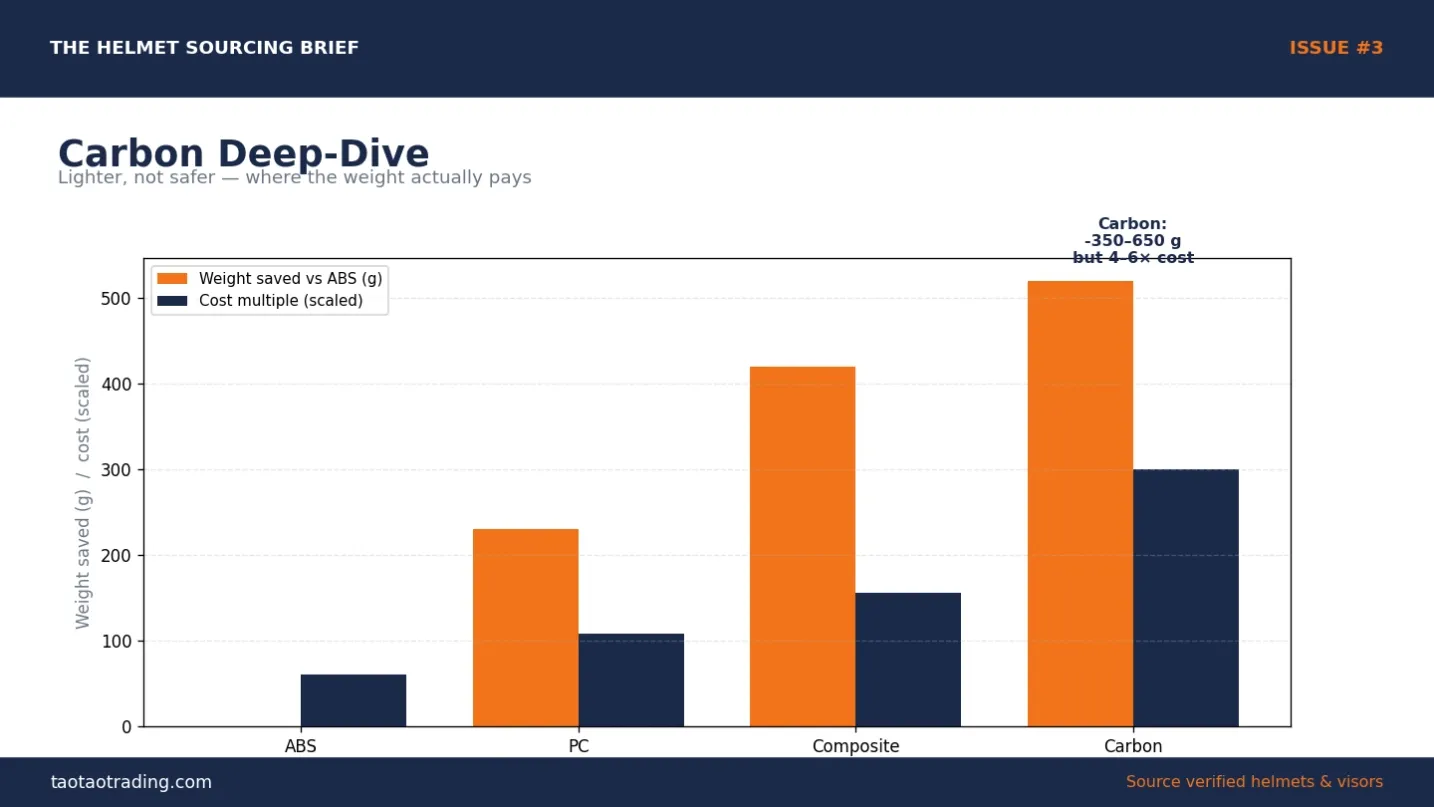
- ABS and polycarbonate (PC): pass — typical full-face baseline; PC saves 70–370 g
- Fiberglass / composite: pass — saves 200–500 g
- Carbon fiber: pass — saves 350–650 g, the highest neck-fatigue benefit
Illustrative comparison: weight saved = typical full-face versus ABS baseline, indicative. Ask for finished-helmet weight per size, not shell-weight claims.
The cost curve is steep early and flat late: ABS to PC is the cheap win; carbon costs 4–6× at shell level for the last grams. On a finished helmet the multiple dilutes, but it never disappears — which is why carbon belongs at the top of a range, not in a volume program.
When Carbon Genuinely Pays
Carbon earns its price in exactly three cases:
- Long-distance / touring riders — 300 g less on your neck over 8 hours is real comfort, and comfort drives reviews and repeat purchases.
- Track / racing — the FIM racing helmet standard (mandatory for competition from 2026) pairs naturally with lightweight shells; status and regulations align.
- Brand flagship — you need a hero SKU to anchor premium positioning, and the shell material is the visible story.
It does not pay for commuting, fleet programs or price-sensitive export lines. There, PC is the rational hero: same certified protection, better supply security and no capacity risk.
Carbon Capacity Is the Real Supply-Chain Constraint
Carbon prepreg needs controlled lay-up plus autoclave or RTM curing: fewer production lines, longer cycles and less flexibility. In peak season (Q3–Q4, pre-holiday), carbon allocations get cut first while ABS and PC lines scale easily.
Importer move: cap your carbon line deliberately and plan it a quarter ahead. Sequence carbon samples early and confirm capacity in writing before you promise a launch date — do not let a flagship SKU blow your volume deliveries.
Pair the Visor Like a Pro
If you do run carbon, pair it right: mirror coatings, 200-level Pinlock inserts and photochromic options. A bare clear visor on a carbon flagship reads as a mismatched spec to professional buyers — and the visor is where repeat-purchase margin lives (full visor economics in Issue #5). As always: a visor is model-specific and must be approved with the helmet, never assumed universal.
Is a Carbon Fiber Helmet Safer Than ABS?
No. Under UN R22.06 every approved shell — regardless of material — passes the same impact requirements. You are paying for weight and positioning, not a higher safety bar.
How Much Lighter Is Carbon, Really?
Typically 350–650 g versus an ABS full-face baseline, with composites in between at 200–500 g. Confirm finished weight for every size on the quotation — size range and components move the real number.
Why Is Carbon 4–6× More Expensive?
Prepreg lay-up, autoclave or RTM curing and slower production cycles. The multiple is shell-only; it dilutes on a finished helmet but never disappears.
A Buyer-Focused Carbon Shortlist
- Fleet / commuter: PC or ABS — value plus supply security. See the F609 ABS full-face helmet as the value direction.
- Touring: fiberglass or composite — comfort at distance with a premium finish.
- Racing / flagship: carbon, deliberately capped — F606 FRP/carbon full-face and F605 FRP/carbon full-face.
Compare Taotao Trading helmet directions before you quote:
Request a Model Shortlist
Tell us your market, target standard and volume, and we will shortlist finished configurations — shell material, visor package and certification evidence — before you commit to samples. Request a quotation or browse the helmet catalog.
Official References
This article provides general procurement information and is not legal, testing or certification advice. Confirm requirements for the exact model and destination market.