Aug 27, 2026Industry Insights
The ECE 22.06 Switch: Your 2026 Buying Window
Why 2026 is the buying window for ECE 22.06 helmets: understand the standard shift, verify suppliers with a 7-point checklist, and avoid costly visor mistakes.
By Katherine Tu · Published by Taotao Trading · The Helmet Sourcing Brief · Issue #1 · Originally published August 26, 2026
If you import motorcycle helmets from China, 2026 is not a normal year. A UN ECE helmet-approval transition whose key earlier-series marking deadline arrived in July 2023 is now shaping your buyers' purchasing behavior — and creating a window that smart importers are already exploiting.
This is the first issue of The Helmet Sourcing Brief: no fluff, one sharp trend per edition, hard numbers, a buyer's checklist you can act on, and a shortlist you can actually source. Let's open with the biggest procurement shift of the year.
Spotlight: Why 2026 Is the ECE 22.06 Buying Window
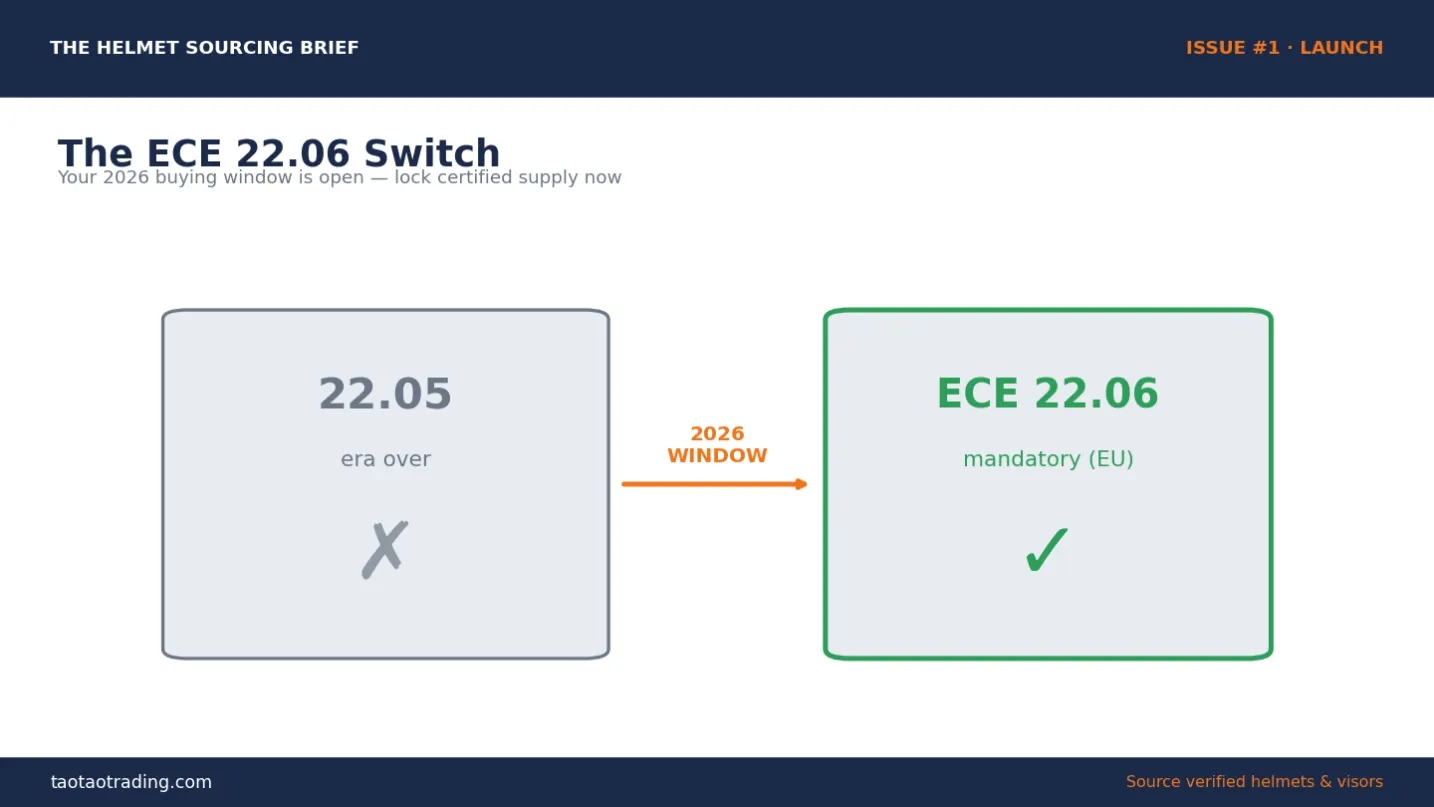
What changed. The ECE 22.06 transition reached a key deadline on 3 July 2023: Contracting Parties applying UN Regulation No. 22 had to stop permitting new approval marks based on earlier series. Existing 22.05 stock was not automatically made illegal. In the market, the commercial impact is peaking now — and here's the mechanism:
- The test got harder, not just relabeled. 22.06 introduced rotational-impact (oblique) testing that measures rotational kinematics during an angled impact. It also tightened assessment of submitted visors and fitted or specified accessories. Visors may also be separately approved, and communication accessories can be universal or helmet-specific; R22 assesses their passive-safety effect, not communication performance.
- 22.05 stock is being cleared. Distributors sitting on 22.05 inventory are quietly discounting it out. Fresh 22.06 SKUs are what EU end-users now search for and what retailers want on shelf.
- Two certs, two markets. DOT is self-certified (US, manufacturer declaration). ECE uses third-party type approval. They do not recognize each other. A buyer asking only for DOT is fine for the US — but non-compliant for Europe. A dual-market helmet must independently satisfy both regimes and may need separate components, markings, documentation, or production-control flows.
- The importer's play. Lock in 22.06-certified suppliers now, before peak season compresses lead times to 1–3 months and everyone competes for the same certified shells. The window is about secure supply, not just compliance.
🎓 Buyer's Class: 7-Point ECE 22.06 Verification
Cert papers are cheap to print. The helmet isn't. Before you wire a deposit:
- Cert number matches the exact model — not the series or family.
- Visor approval matches the exact configuration — confirm the submitted or separately approved visor is covered by the approval and compatible with the helmet.
- Rotational-impact data present on the document (oblique test, not just a linear drop).
- Manufacturer holds the production approval, not just a trading company's paper.
- Batch traceability: mold ID and production date are visible on the liner or label.
- Pinlock-ready shields list the level (30 / 70 / 120 / 200) — these are Pinlock performance tiers, not ECE grades.
- Independent lab or technical-service name appears on the approval documentation — ECE is third-party type approval, never self-declared.
Common fakes to watch: a 22.05 cert reused for a 22.06 listing; a cert for model A pasted onto model B; a test report with no lab letterhead. Any of these can mean a return, a customs hold, or worse.
🛡️ Visor Lab: Pinlock vs ProtecTINT
Most returns aren't about the shell — they're about the visor.
- Anti-fog: factory hydrophilic coating wears off in weeks. Pinlock dual-lens is the de-facto standard (166+ brands; levels 30/70/120/200).
- Photochromic: ProtecTINT is a light-activated clear-to-light-smoke insert. Day/night status depends on the exact approved visor/insert combination and its marking.
- Mirror coatings reflect IR but scratch easily; no ammonia cleaners.
- Key point: a visor is not universal. Verify the exact approved visor or inner-visor configuration for the helmet. Spec it wrong and the whole box can come back.
✅ This Week's Shortlist
Sourcing-ready from verified ECE 22.06 + DOT factories:
👉 Full catalog & quotation: taotaotrading.com
❓ FAQ
Q: Can one helmet carry both DOT and ECE?
A: Yes — many factories produce a single shell tested to both standards, with two labels. But the production and documentation are separate; verify both certifications name the exact model.
Q: Is carbon safer than ABS?
A: No. Certified ABS that fits the head form protects as well as carbon. Carbon wins on weight (200–400g less), not safety. Don't pay a premium expecting more protection. (Full myth-bust in Issue #3.)
Q: How fast can I get a private-label run?
A: With an existing mold and held approvals, 1–3 months in peak season. A new private mold adds tooling time — plan a quarter ahead.
📩 Subscribe & Source
If this brief saved you an hour of supplier screening, subscribe — next issues cover shell-material selection by market, the carbon-vs-ABS myth, and a fleet-procurement playbook. For the current catalog and a quotation, contact us at taotaotrading.com.