Aug 10, 2026
EN 1154 Door Closer Codes Explained
Learn how to read the EN 1154 six digit classification code, why the fourth digit decides fire door eligibility, and what documents to request from suppliers.
Most door closer quotations look identical on paper. Same finish options, same warranty language, same reassuring line about CE marking. The prices differ by twenty or thirty percent and nobody can explain why.
Then the site inspection happens and one supplier's product gets rejected.
The information that would have predicted this was available from the start. It was sitting in a six digit code on the product nameplate, and almost nobody reads it.
This article explains how to read that code, why the fourth digit matters more than the other five combined, and what a serious supplier should be able to hand you without hesitation.
The problem is not fake certificates
Before getting into the code itself, it helps to name the failure mode correctly, because most buyers are guarding against the wrong thing.
The common assumption is that risk comes from forged documents. In practice, forged certificates are relatively rare and relatively easy to catch, because notified body numbers can be verified.
The far more common problem is drift.
A factory holds a genuine test report for one flagship system. Over time, that paperwork gets extended across cheaper systems that were never tested. Nothing is forged. The original report is completely valid. It simply no longer describes the product being quoted.
This is a documentation problem rather than a manufacturing problem, and it is important to understand the difference. The factory may be perfectly capable of building good hardware. What has broken is the link between the certificate and the item in the box.
Drift is harder to detect than fraud because every individual document passes inspection. You only catch it by comparing documents against each other, and against the physical product.
The six digit code, position by position
Every door closer placed compliantly on the European market carries a classification code under EN 1154. You will find it stamped, engraved or printed on the closer body. A typical code looks like this:
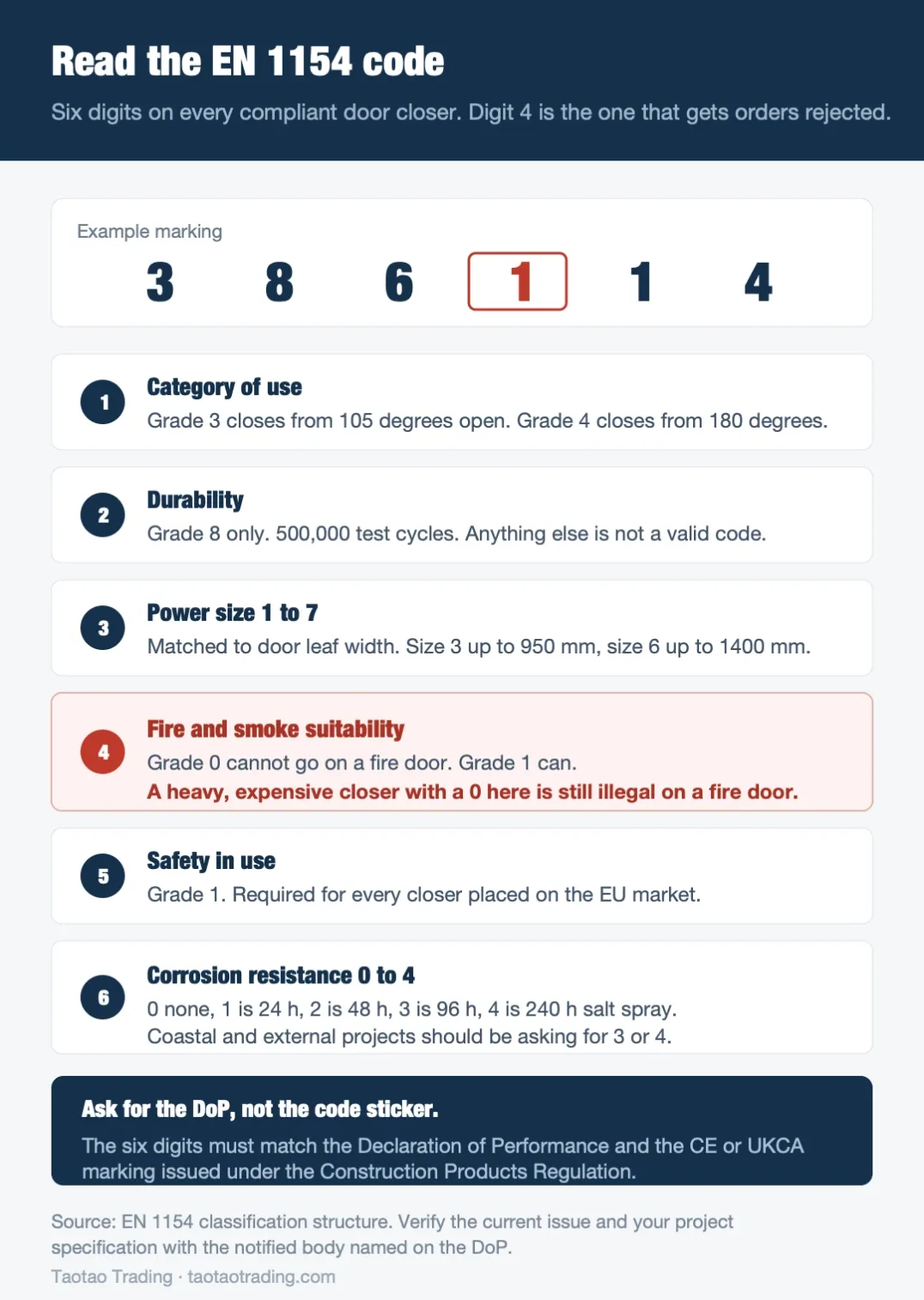
3 8 6 1 1 4
Here is what each position declares.
Position one, category of use. A three indicates the closer returns the door to the closed position from at least 105 degrees of opening. A four indicates it returns from 180 degrees. For most commercial applications, three is standard. Four is specified where doors open fully against a wall.
Position two, durability. There is only one grade here, which makes it the easiest digit to check. It is always 8, and it certifies the unit completed 500,000 test cycles. If you ever see anything other than an 8 in this position, stop and ask why.
Position three, power size. This runs from one to seven and must be matched to the door leaf. Getting it wrong produces doors that slam or doors that fail to latch, and a fire door that does not latch provides no fire protection at all.
Power size | Max leaf width | Closing moment (0–4°) | Max opening moment (0–60°) |
|---|---|---|---|
1 | 750 mm | 9–13 Nm | 26 Nm |
2 | 850 mm | 13–18 Nm | 36 Nm |
3 | 950 mm | 18–26 Nm | 47 Nm |
4 | 1,100 mm | 26–37 Nm | 62 Nm |
5 | 1,250 mm | 37–54 Nm | 83 Nm |
6 | 1,400 mm | 54–87 Nm | 134 Nm |
7 | 1,600 mm | 87–140 Nm | 215 Nm |
Position four, fire and smoke door suitability. Zero means the closer is not suitable for use on fire or smoke door assemblies. One means it is.
Position five, safety. A one confirms the unit meets the safety requirements, which is required for the European market.
Position six, corrosion resistance. Zero means no defined resistance. One means 24 hours. Two means 48 hours. Three means 96 hours. Four means 240 hours. Coastal and industrial environments should be specifying three or four.
Why position four ends projects
If a project specification calls for fire rated doors and the quoted closer carries a zero in position four, that closer cannot be used. Not with a waiver, not with a heavier model, not with a longer warranty.
The reason buyers miss this is that a zero rated closer can look and feel more substantial than a one rated closer. Weight and build quality are not what position four measures. It measures whether the unit was tested and classified for use within a fire or smoke door assembly.
There is a second layer that causes almost as much trouble.
A one in position four means the closer is eligible for fire door use. It does not mean the door is compliant.
A fire door is a system, not a collection of parts. When a fire door assembly is tested to EN 1634-1, the leaf, the frame, the closer, the hinges and the intumescent seals are tested together as a single configuration. Substituting any component, installing it incorrectly, or omitting a part invalidates the fire rating of the assembly.
So there are two separate questions, and buyers routinely collapse them into one.
Is this closer classified for fire door use? Read position four.
Is this specific door assembly fire rated? Ask for the EN 1634-1 assembly test report and confirm that the components listed in it match the components in your quotation.
Assembling individually compliant parts does not produce a compliant fire door.
The three point alignment check
The method we use internally takes about four minutes per line item, and it comes directly from credit risk review rather than from the hardware industry.
The principle is that a claim is only as strong as the agreement between independent representations of it. So we compare three.
First, the certificate. What model number, tested configuration and issuing body does the document actually name.
Second, the quotation. What system, power size, finish and accessories are actually being offered, in writing.
Third, the physical unit. What is stamped on the nameplate of the sample or the production item.
When all three agree, the claim holds up in front of a customs officer, a site inspector or a client's technical team. When any two disagree, there is a problem, and finding it before shipment costs a fraction of finding it after installation.
In practice, the third point is the one that gets skipped, because it requires a sample or a clear nameplate photograph rather than an email attachment. That is exactly why it is the most valuable of the three. Anyone can forward a PDF. A nameplate photograph is evidence about the specific goods being shipped.
What to request from any door hardware supplier
Use this as a checklist when qualifying a new source.
A product specific Declaration of Performance referencing EN 1154, matching the exact model quoted, not the product family.
The initial type testing report from a notified body, with the tested configuration clearly stated.
Evidence of factory production control, showing the manufacturer runs a documented and audited process rather than relying on a one time test.
For fire door applications, the EN 1634-1 assembly test report, with a component list that matches your quotation.
Corrosion resistance classification evidence supporting the sixth digit, particularly for coastal, marine or industrial projects.
A clear photograph of the nameplate on the actual production unit, taken during or immediately after production.
A supplier that can produce all six without delay is a supplier that has done the work. A supplier that sends a folder of general certificates and asks you to trust the brand is telling you something useful.
Frequently asked questions
Is CE marking on its own enough for a fire door project? No. CE marking indicates the product is placed on the market in accordance with the applicable requirements. It does not tell you the classification of the specific unit. You still need to read the EN 1154 code and confirm position four, and for fire doors you need the assembly level evidence as well.
Can a power size be adjusted on site to fix a mismatch? Many closers offer adjustable power within a range, for example EN 2 to EN 4. That adjustment operates within the classified range on the nameplate. It does not allow a unit classified below the required size to be used on an oversized door.
Does UK procurement follow the same code? UKCA marking runs in parallel with CE for the UK market. The EN 1154 classification structure remains the technical reference, but the conformity marking route differs. Confirm the current requirement with your notified or approved body, as transitional arrangements have changed more than once.
What about aluminium windows rather than door hardware? Aluminium windows fall under the harmonised standard EN 14351-1, with separate performance classes for air permeability, watertightness, wind load resistance, thermal transmittance and acoustic performance. The AVCP system is level 3 for standard windows and rises to 1+ where fire resistance under EN 16034 is involved, which changes the level of notified body involvement substantially. The same three point alignment check applies.
Our previous supplier passed inspection. Why check again on a repeat order? Because drift happens between orders, not within them. Tooling changes, material substitutions and model updates all break the link between a valid certificate and the current production run. Repeat orders are where drift accumulates unnoticed.
Regulatory note
Construction products in the EU are now governed by Regulation (EU) 2024/3110, which replaces Regulation (EU) No 305/2011. Transitional arrangements and the referenced versions of harmonised standards continue to develop. Confirm the applicable version and transition timing with the notified body that issued your documentation, and treat this article as an orientation rather than a legal determination.
Outside the EU, requirements differ. The United Kingdom operates UKCA alongside CE. Australia and New Zealand reference AS 2047 and AS 1288 for windows. The United States uses NFRC, AAMA and ASTM references together with local building codes, with no direct CE equivalent.
Working with Taotao Trading
We supply door closers, architectural hardware, aluminium and thermal break windows, motorcycle helmets, helmet visors and racing spoilers to buyers in the United States and Europe.
The reason we lead with documentation rather than price is straightforward. Our founder spent over a decade in bank corporate credit risk before moving into trade, which means certificate review is a professional habit rather than an afterthought. We run the three point alignment check on every line item we quote, and we request nameplate photographs from our factories as standard practice rather than on request.
Our full documentation index, including EN 1154 and EN 14351-1 references, sits on our certifications page. There is no form to fill in and no email gate.
Visit taotaotrading.com/certifications to review what we hold, or send us the specification you are working against and we will tell you within one working day whether we can support it and what evidence we can provide.