Sep 8, 2026Industry Insights
Motorcycle Helmet Fleet Procurement: Spec Volume Orders Without Killing Margin
A fleet procurement playbook for helmet importers: what a volume order is actually judged on, indicative fleet economics, and how to spec volume orders without killing margin.
By Katherine Tu, Founder & Sourcing Lead at Taotao Trading — The Helmet Sourcing Brief, Issue #4
Issue #3 settled the carbon question: every certified shell clears the same pass bar, and carbon only pays for touring, track and flagship lines. But the biggest volume buyers in this category were never going to buy carbon anyway. Delivery platforms, courier fleets and rental operators buy helmets by the thousand — and they buy them on completely different rules than a retail brand does.
This issue is the fleet playbook: what a volume order is actually judged on, where the hidden costs live, and how to spec a fleet program that survives contact with operations — without giving away your margin.
This is Issue #4 of The Helmet Sourcing Brief — the fleet companion to Issue #3 (carbon deep-dive), Issue #2 (shell materials by buyer segment) and Issue #1 (the ECE 22.06 verification framework).
Spotlight: What a Fleet Order Actually Tests
A retail buyer judges a helmet sample. A fleet buyer judges a system. When a delivery platform quotes 2,000 units, the order is really being tested on four gates at once: certified compliance for the destination market (the ECE 22.06 framework from Issue #1 applies per model, not per batch), consistency across the whole production run, rider compliance — whether the helmet is actually comfortable enough to be worn — and replacement economics over the program's life.
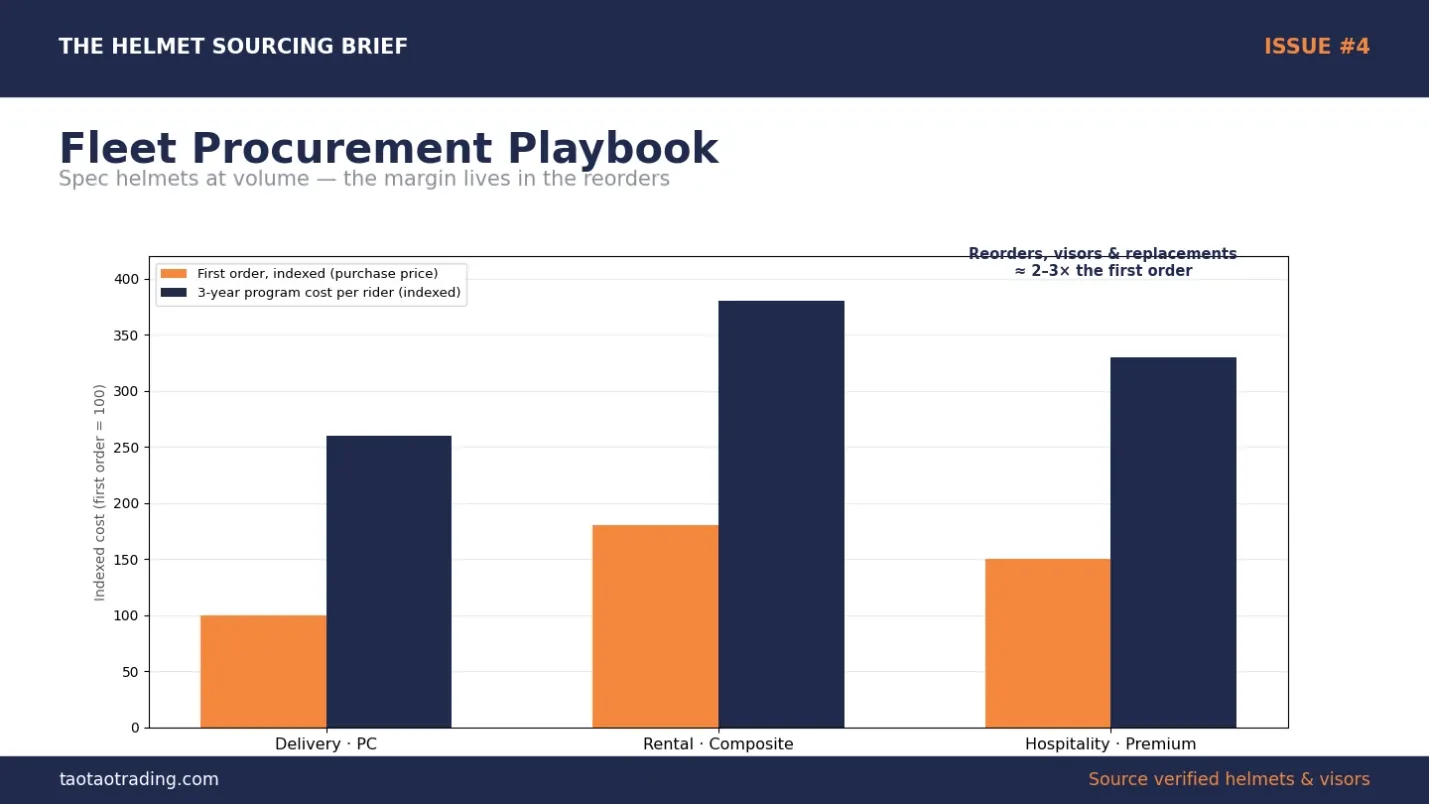
The last gate is the one importers miss. A fleet program is not a purchase; it is a subscription. Helmets get dropped, lost and taken home. Visors get scratched every few months. If your proposal only prices the first delivery, your margin dies in the reorders you never quoted for — or in the penalty clauses you agreed to without reading.
Chart idea #1 — Fleet order gates: four columns (certification, batch consistency, rider comfort, replacement economics) with the most commonly missed one highlighted.
By the Numbers
- Helmet replacement cycle, delivery fleets: 12–18 months
- Loss / damage rate per year: 5–10% of units
- Visor replacements per helmet lifetime: 2–3
- Spare-visor ratio to quote: ~1 visor per 3 helmets per year
- Size curve, delivery fleets: S ~10% · M ~40% · L ~35% · XL ~15%
- Volume price breaks to expect: 500 / 1,000 / 5,000 units
- Branding MOQ (print or decal): often 300–500 units per design
(Figures are indicative planning ranges from fleet program experience, not guarantees; confirm every number against the specific operator, market and model.)
The pattern behind the table: the first order is the smallest part of the relationship. A 2,000-unit fleet program with 12-month replacement cycles and real visor demand is a 5,000+ unit conversation over three years — provided the first batch survives operations.
Buyer's Class: Which Fleet Buys What
Fleets do not all buy the same helmet, and quoting the wrong shell material kills margin in both directions:
- Food delivery & courier platforms — polycarbonate (PC). High turnover, all-weather riding, branding-heavy. PC gives certified protection, the best supply security (Issue #3) and the lowest landed cost at volume.
- Rental & touring operators — fiberglass composite for the guided/premium tier, PC for the mass tier. Composite holds up better to daily handling and photographs better in a premium catalog.
- Hospitality & guest-experience programs — appearance and comfort dominate; ABS or PC with a strong finish package. Carbon almost never pays (Issue #3) — except as a small upsell tier.
The common mistake is over-specifying. A fleet buyer who buys carbon "because it is better" pays 4–6× the shell cost for grams no rider will notice at 30 km/h — and gets worse delivery security in peak season.
Supply Chain Watch: Volume Capacity Is Negotiated, Not Assumed
Fleet orders are lumpy by nature — one PO can be three months of a factory's normal retail run. In Q3–Q4 peak season, a bulk order that arrives unannounced competes with every retail program for ABS/PC injection capacity and visor supply. Factories prioritize the programs that reserved capacity in writing.
Importer moves that protect both delivery and margin: reserve capacity a quarter ahead with a scheduled PO; agree the size curve at order stage, not at packing; put the spare-visor supply and price on the same contract as the helmets; and book a pre-shipment inspection (AQL 2.5 is the common line for general appearance, with certification markings and buckle function on the critical list) so consistency problems surface in Guangzhou, not in the operator's depot.
Chart idea #2 — Capacity calendar: Q3–Q4 congestion vs fleet PO timing.
Visor Lab: One Helmet, Three Visors
Fleet riders ride at night, in rain and against low sun — one clear visor is not a spec, it is a complaint generator. Quote fleets a visor plan, not just a visor: clear as the standard fit, a tinted option where the market allows it, and Pinlock-grade anti-fog for the all-day riders. Quick-release visor mechanisms matter more to fleets than to retail buyers: a rider swaps a scratched visor at the depot in seconds instead of mailing a helmet to a workshop.
A visor is model-specific and must be approved with the helmet, not assumed universal — the same rule from Issue #3, and the reason visor supply belongs in the fleet contract (full visor economics in Issue #5).
FAQ
What MOQ should a fleet pilot order be?
Large enough to prove the system, small enough to redo: 100–300 units is the common pilot band. Run the pilot for one full replacement cycle, then lock the volume contract with the size curve and visor ratio the pilot proved.
How do we keep batch consistency across reorders?
Fix the reference sample: seal a production sample from the first batch, and write "reorders must match sealed sample" into the contract with inspection rights. Materials, paint codes, buckle brands and visor tooling should be named in the spec, not left to "same as before".
PC or ABS for delivery fleets?
Both certify. PC wins on weight (70–370 g less than ABS — Issue #3), rider comfort and thin-wall molding economics at volume; ABS wins on raw material cost and scratch tolerance. For all-day riders, PC is the rational default.
This Week's Shortlist
- Delivery / courier fleets — PC. Value + supply security + comfort
- Rental / touring premium tier — Composite. Durability + premium feel
- Pilot / mixed programs — PC or Composite. Prove the system, then scale
Compare Taotao Trading helmet directions:
F609 full-face helmet (ABS value line) — the value-line base for delivery fleet programs; PC direction available on request
F606 FRP/carbon full-face helmet — composite direction for rental and touring premium tiers
F605 FRP/carbon full-face helmet — composite flagship direction for pilot programs that need a premium anchor
Request a Model Shortlist
Tell us your rider count, use intensity, target market and standard, and we will shortlist finished configurations — shell material, visor package, size curve and certification evidence — before you commit to a pilot order.
The Helmet Sourcing Brief — China helmet & visor insights for importers. Published by Taotao Trading. Next issue: Visor Economics — the spare-part margin most importers leave on the table.
Official References
This article provides general procurement information and is not legal, testing or certification advice. Confirm requirements for the exact model and destination market.