Aug 28, 2026Industry Insights
Motorcycle Helmet Shell Materials: ABS vs PC vs Fiberglass vs Carbon Fiber
Compare ABS, polycarbonate, fiberglass composite and carbon-fiber motorcycle helmet shells by buyer segment, weight target, cost, lead time and sourcing risk.
By Katherine Tu, Founder & Sourcing Lead at Taotao Trading
Choosing a motorcycle helmet shell by price alone is a common sourcing mistake. ABS, polycarbonate, fiberglass composite and carbon fiber are not a simple good-better-best ladder. Each material can serve a different buyer segment, retail position, weight target and production plan.
For importers and private-label brands, the useful question is not “Which material is best?” It is “Which finished helmet configuration fits my market, target standard, volume, price position and supply risk?”
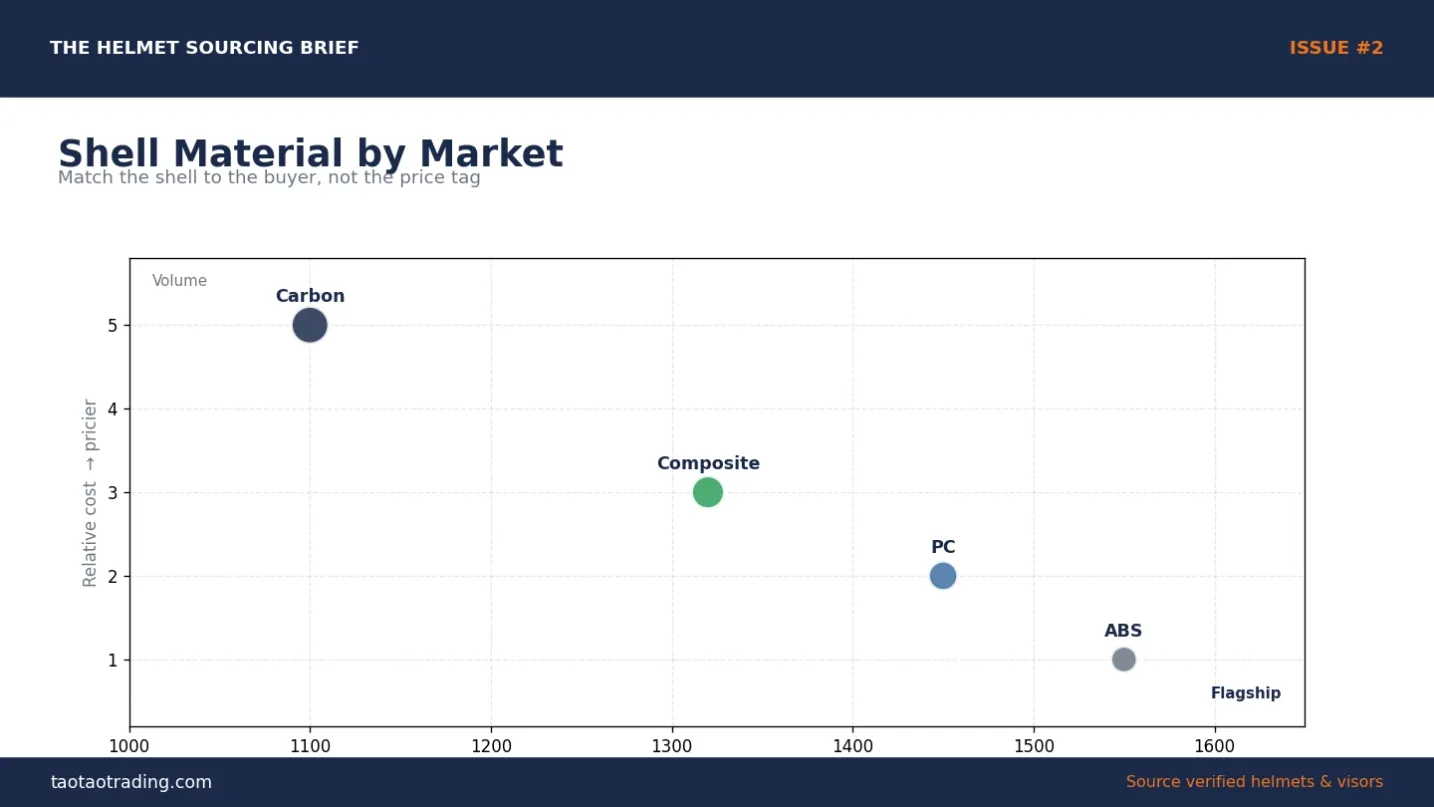
Illustrative comparison: shell weight and cost vary by model, size, construction, components and supplier quotation. The cover chart is a sourcing-position guide, not a certification or safety ranking.
Match the Shell to the Buyer, Not the Price Tag
Use the market brief to narrow the shell direction before asking factories for quotations.
- ABS often fits value and volume programs where repeatability, broad supplier availability and unit economics matter.
- Polycarbonate (PC) is common in mainstream programs that need a balance of weight target, price and scalable production.
- Fiberglass or composite is frequently positioned for touring and premium ranges where finish, comfort and product story can support a higher retail price.
- Carbon fiber belongs in flagship programs where low-mass potential, visible material and premium positioning justify higher cost and tighter production planning.
These are commercial positions, not universal rules. The finished helmet must still be evaluated model by model.
ABS Motorcycle Helmet Shells: A Practical Volume Option
ABS is widely used in value-focused motorcycle helmets. It can be a practical choice for fleet, entry-level and promotional programs when the supplier has stable tooling and a suitable approved configuration.
Ask the supplier to confirm:
- finished helmet weight for every relevant size;
- number of shell sizes across the size range;
- exact model and target-market compliance evidence;
- color, graphics, packaging and spare-visor MOQ;
- whether logo, visor or accessory changes affect the offered configuration.
Do not treat “ABS” as shorthand for low quality. The real procurement risk is an incomplete specification, weak production control or evidence that does not match the exact helmet being ordered.
Polycarbonate Helmet Shells: Compare the Finished Configuration
Polycarbonate is another thermoplastic option used across mainstream helmet programs. It may support a competitive balance of weight, price and production scale, but the material name does not guarantee a specific finished weight.
Compare samples in the same size and configuration, including the visor, inner sun visor, liner, retention system and accessories. Record the agreed weight and tolerance in the product specification rather than relying on a catalogue headline.
Key sourcing checks include tooling ownership, shell-size coverage, UV and finish requirements, production consistency and change control.
Fiberglass and Composite Shells: The Premium Middle
Fiberglass-reinforced and mixed-composite shells are often used for touring or premium motorcycle helmets. Their value proposition may include lower weight, finish quality and a more premium construction story. The result still depends on the exact laminate, process and finished design.
Before ordering, verify:
- the construction and manufacturing process used for the offered model;
- material traceability and workmanship controls;
- cosmetic acceptance criteria;
- shell-weight variation across samples and sizes;
- normal output, peak-season capacity and realistic lead time.
Composite is not one single specification. Put the agreed material and construction into the purchase specification, then control changes during production.
Carbon-Fiber Helmet Shells: A Flagship, Not a Safety Shortcut
Carbon fiber can support a lower finished-weight target and strong premium positioning. It can also bring higher material cost, visible cosmetic requirements and more demanding production control.
The most useful buyer question is: Will the customer pay for the verified weight, finish and brand value of this exact helmet?
Avoid generic claims such as “carbon saves 300 grams.” Any weight advantage should be checked on the offered model, in the offered size and with the exact visor, liner and accessories included.
Is Carbon Fiber Safer Than ABS?
Not automatically.
UN Regulation No. 22 and FMVSS No. 218 are performance-based requirements for the finished helmet. They do not establish a blanket material ranking in which carbon is always safer than fiberglass, PC or ABS.
The shell is one part of a system that includes the energy-absorbing liner, geometry, retention system, visor and other components. A compliant carbon helmet is therefore not automatically safer than a compliant ABS helmet, and two helmets that meet a standard should not be assumed to provide identical performance in every impact.
Carbon’s clearest commercial advantage is its potential to reduce weight while supporting a premium product story. Verify that benefit with model-level samples and documents.
Why “Certification Readiness by Material” Is Misleading
Avoid comparison tables that label ABS or PC “easy to certify” and carbon “harder to certify.” Compliance depends on the finished helmet type and the target-market framework, not the shell material alone.
- Under UN Regulation No. 22, approval relates to a defined helmet type and configuration.
- In the United States, the manufacturer self-certifies conformity to FMVSS No. 218; NHTSA does not pre-approve individual helmet models.
- A different shell material, visor, retention system or accessory should not be assumed to be covered by another model’s evidence.
For procurement, match the quotation, approval or certification evidence, sample and purchase specification to the same exact model and configuration.
Shell Material, Capacity and Lead Time
Thermoplastic shells such as ABS and PC are commonly associated with injection-molded, higher-volume programs. Fiberglass and carbon constructions can involve more labor and process control. This changes the capacity questions buyers should ask, but it does not create one universal lead-time rule.
Confirm:
- available molds and shell sizes;
- normal and peak-season output;
- material availability and traceability;
- cosmetic and weight tolerances;
- sample, graphics and packaging approval timing;
- how material or process changes are reviewed against the approved specification.
A practical portfolio often puts the most repeatable configuration at the center of the range and manages complex carbon finishes as a controlled flagship program.
Match the Visor Package to the Buyer Segment
Pinlock compatibility is visor-specific, not determined by shell material. Pinlock lists four anti-fog performance levels—30, 70, 120 and 200—and availability must be checked for the exact visor.
ProtecTINT is a light-activated insert option. Its day/night status and suitability depend on the exact approved visor/insert combination and markings. Do not generalize one product page or one helmet configuration to the whole range.
For value programs, spare clear visors and verified Pinlock-ready compatibility may matter more than a premium coating. For flagship programs, mirror or photochromic options can support the offer if compatibility, markings, samples and replacement supply are confirmed.
A Buyer-Focused Shell Shortlist
- Value or fleet program: start with ABS or PC; prioritize repeatable quality, size coverage, replacement visors and landed cost.
- Mainstream retail: compare ABS and PC finished samples; balance weight, comfort, finish and retail margin.
- Touring or premium: evaluate fiberglass or composite; control workmanship, weight variation and lead time.
- Flagship: evaluate carbon or carbon-composite; confirm the real weight advantage, cosmetic standard, capacity and spare-parts plan.
Compare Taotao Trading Helmet Directions
Current catalogue examples include:
Product availability, supporting documents, MOQ, lead time and customization options must be confirmed for each inquiry. Certification claims should be checked against the exact model, material and destination market.
Request a Model Shortlist
Send Taotao Trading your target market, expected quantity, required standard, retail price position, preferred shell direction and customization needs. We can help compare suitable models, organize supplier questions, coordinate samples and follow up with selected factories in South China.
Official References
This article provides general procurement information and is not legal, testing or certification advice. Confirm requirements for the exact model and destination market.