Oct 3, 2026Industry Insights
How to Read an ECE 22.06 Approval Mark: E Number, Approval Number and Mismatch Red Flags
How to read an ECE 22.06 approval mark: E numbers, approval numbers, J/P/NP/P-J codes, visor marks and eight red flags to check before ordering from a supplier.
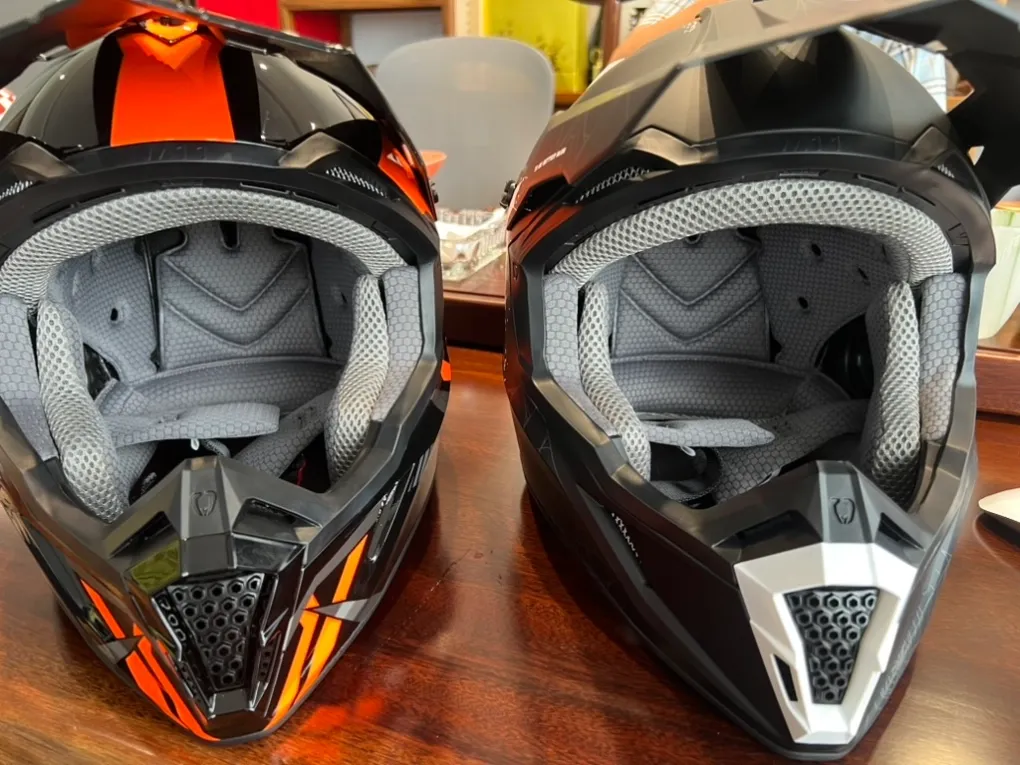
Photo: off-road helmets from our own range. Every element in this guide lives on the label sewn into the chin strap — which is exactly the close-up your first supplier photo request should capture.
- 选题编号:A12(选题库:helmet-content-sources-and-topic-bank-2026-10-03.md)
- 状态:草稿完成,待 Katherine 审核确认 → 确认后发布
- 标题:How to Read an ECE 22.06 Approval Mark: E Number, Approval Number and Mismatch Red Flags
- 建议 Slug:`ece-22-06-approval-mark-e-number-red-flags`(可读英文关键词,非数字)
- 目标关键词:ECE 22.06 approval mark;辅助:E number helmet、ECE 22.06 label、helmet approval number、ECE 22.06 red flags
- SEO 描述(约 160 字符):How to read an ECE 22.06 approval mark: E numbers, approval numbers, J/P/NP/P-J codes, visor marks and eight red flags to check before ordering from a supplier.
- 意图簇:认证与合规(A 簇)|产品线:摩托盔 + 镜片|格式:清单体|字数:约 1050 词
- SERP 实查(2026-10-03):前位为零售商页/社区帖/文档分享站,无大媒体深度文,可打
- 事实核实(2026-10-03):全部标识条款对照 UN R22.06 官方整合文本(E/ECE/324/Rev.1/Add.21/Rev.5,127 页,经官方 PDF 核对),引用条款:4.1.1、4.1.2、5.1.2、5.1.4.1.1–5.1.4.1.5、5.1.5、5.1.7、5.1.8、5.1.10、5.1.13、5.2.4、Annex 2A、Annex 2B;E 国编号清单出处 R.E.3 Annex 3(法规脚注 3),正文只列无争议的 E1–E13
- 官方来源链接:https://unece.org/transport/documents/2021/08/standards/un-regulation-no-22-rev5-06-series
- 内链(3 条):ece-22-06-helmet-safety-gate-supplier-checks|ece-22-06-visor-pre-shipment-document-marking-check|/products/mx802-carbon-fiber-adventure-helmet-carbon-peak
- 配图(2026-10-03 Katherine 提供,已确认使用):头图 = 自家两顶越野盔内部实拍(原图 `2026-10-03-mx-helmets-interior-original.jpeg`,网页版 `2026-10-03-mx-helmets-interior-web.jpg` 1024×768/246KB)。上传后请把正文中的 `IMAGE_PLACEHOLDER_2026-10-03-mx-helmets-interior-web.jpg` 替换为实际上传 URL。图注按现状如实描述(标签在照片中不清晰可辨,图注只说"标签缝在下巴带上"这一法规事实,未称图中可见)。官方标识示例图(`2026-10-03-r22-annex2a-helmet-mark-example.png`)作为可选第二张图,使用时标注 "Source: UN Regulation No. 22, Annex 2A"
- 发布动作提醒:后台"更新"≠"发布",保存后必须点前台"发布";发布后 GSC 提交收录
# How to Read an ECE 22.06 Approval Mark: E Number, Approval Number and Mismatch Red Flags
Before you wire a deposit to a helmet supplier, there is a check that costs nothing and takes five minutes: read the approval label sewn into the chin strap. UN Regulation No. 22.06 requires every approved helmet to carry a specific set of information, and the label alone can expose a supplier whose paperwork does not match the product. This guide breaks down each element of the mark, explains the J / P / NP / P/J codes, shows what the E number does and does not tell you, and finishes with eight red flags worth walking away from.
What a compliant 22.06 mark must show
Annex 2A of the Regulation gives an official worked example. On a Dutch-approved open-face helmet, the label reads:
Ⓔ4 — 061406/J-1952
Five elements, each with a defined job (the paragraph numbers refer to UN R22.06):
1. A circle around the letter "E", followed by the country number — the distinguishing number of the authority that granted the approval (5.1.4.1.1). In the example, E4 = the Netherlands.
2. The approval number, six digits, starting with "06" — the Regulation states that the first two digits show the amendment series under which approval was granted; for approvals issued today, that is 06, i.e. 22.06 (5.1.2). The remaining digits are the serial the authority assigned to that helmet type. In the example: 06 + 1406.
3. A slash and a protection symbol — J, P, NP or P/J, explained below (5.1.4.1.2.1).
4. A dash and a production serial number — continuous for all helmets of that approved type, with the authority keeping a register to cross-check type against serial (5.1.4.1.2.2). In the example: -1952.
5. Legible and permanent placement — characters at least 8 mm high (Annex 2A), clearly legible and resistant to wear (5.1.4.1.4), and the label must be sewn to the retention system — the chin strap (5.1.10).
Separately, the shell itself must also show the manufacturer's trade name or mark, the size in both letter and centimetres, and the year of production (4.1.1). A helmet missing any of these basic markings deserves a question before an order.
The four letters: J, P, NP and P/J
The symbol after the slash tells you what the chin area actually does — and it must match the helmet you are buying:
- J — No lower face cover (Open face / jet)
- P — Protective lower face cover (Full face)
- NP — Detachable or movable cover that is non-protective (Jet with a chin cover that is not impact-rated)
- P/J — Detachable or movable protective cover (Modular / flip-up, dual-homologated)
Two practical notes. First, NP exists precisely so that a chin cover which looks protective but is not tested as such cannot pass silently — if your supplier's "full face with chin guard" is actually an NP approval, you are buying less protection than the product photo suggests. Second, P/J matters to modular-helmet buyers: it is the dual homologation covering the helmet both with the chin bar up and locked down.
Which country is "E4"? What the E number does — and doesn't — mean
The numbers you will most often see on labels:
- E1 Germany · E2 France · E3 Italy · E4 Netherlands · E5 Sweden · E6 Belgium · E7 Hungary · E8 Czech Republic · E9 Spain · E11 United Kingdom · E12 Austria · E13 Luxembourg
The full list of distinguishing numbers is published in Annex 3 of the UNECE R.E.3 consolidated resolution.
Here is the part importers misuse: the E number identifies the approval authority, not the factory location and not a sales restriction. A helmet made in Guangdong can legitimately carry an E4 mark, because the Dutch authority approved the type through its designated technical service. And an approval granted by one contracting party to the 1958 Agreement is accepted by the others applying the Regulation — you do not need a separate "French E2" to sell in France. So treat claims like "our German E1 approval proves better quality" as marketing; the number only tells you who examined the type.
The visor has its own mark
A visor approved together with a helmet carries its own approval mark: the circled E with country number, an approval reference, and a production serial (5.1.5). If the visor is restricted to daytime use, the mark includes the daytime-only symbol — a dark-tinted visor without it should raise questions (4.1.2). The marking must sit outside the main visibility area (5.1.7), and an ultra-destructive label is accepted on visors because they cannot be sewn.
Two visor checks buyers skip. If you are sourcing aftermarket visors sold separately — the bulk of the replacement-visor trade — those need their own approval under the Regulation (5.2), not just a reference to the helmet's certificate. And the helmet's approval certificate lists the visor types approved with it, so a supplier claiming "any visor fits" is drifting from the documented type (3.2.1.3).
Eight red flags: when the mark says "walk away"
1. The number does not start with 06 while the quotation says 22.06. A "05" prefix is an approval to the previous series, not this one (5.1.2).
2. The same approval number appears on two different models. Each approved type gets its own number; the Regulation forbids assigning one number to another type (5.1.2).
3. Missing or mismatched protection symbol — a full-face helmet whose label ends in /J, or an open-face wearing /P (5.1.4.1.2.1).
4. No production serial number after the dash (5.1.4.1.2.2).
5. A sticker instead of a sewn-in label, or print that rubs off — the mark must resist wear, and the label belongs on the retention system (5.1.10, 5.1.4.1.4).
6. A QR code replacing the E mark. A barcode or QR may be added in addition, never used instead (5.1.4.1.5, 5.1.8).
7. Certificate and label disagree — model, brand, size range or year on the approval certificate that do not match the sample photo you were sent.
8. A visor sold separately with no mark of its own, or a "22.06 helmet + visor" bundle whose certificate never lists the visor (5.1.5, 3.2.1.3).
None of these prove bad faith on their own — but every one of them means the paperwork is incomplete, and incomplete paperwork becomes your problem at the border or in a liability claim.
Run the check before the deposit, not after
One discipline from my years reviewing corporate loan files: single documents tell stories; documents read against each other tell truths. The label check works the same way. Before ordering:
1. Ask for a close-up photo of the sewn-in label on the exact size and colourway you plan to order — not a brochure photo.
2. Ask for the approval certificate and match: approval number, approval holder, model name, and the size range covered.
3. Ask for the test report cover page and confirm the technical service and date line up with the certificate.
4. On the golden sample before shipment, re-check the label against all three.
Reading the mark is the fastest test of a supplier's documentation discipline. The heavier checks — CoP records, Safety Gate history, production audit — sit on top of it, and we cover them in our guides to ECE 22.06 supplier checks and pre-shipment visor document reviews.
Get a second opinion on your supplier's label
If you are evaluating a helmet supplier and want a documentation check before you commit, send us the label photo and certificate — or ask for the approval documents on our own 22.06 programs, including the MX802 carbon adventure helmet. Taotao Trading manufactures and sources motorcycle helmets and visors for OEM/ODM programs, and we are happy to tell you what a sound document set looks like.
WhatsApp: +86 166 2666 2274
Source: UN Regulation No. 22 — Uniform provisions for the approval of protective helmets and their visors for drivers and passengers of motorcycles and mopeds, 06 series consolidated text (UNECE, Revision 5). Paragraph references follow that text.
Related reading: